Saturday, 1 February 2014

The importance of basic coding for all!


There has been a niggling need within the industry for the last few years for marketing folk to get involved with more of the technical side of digital, rather than sitting back and letting the real techies whizz off Javascript, CSS and HTML5 without us! There are so many tools that allow even the most computer-illiterate of marketeers to get away without any technical experience but I do feel that the emphasis is changing and that coding is now seen as an essential skill for every Tom, Dick and Harry.


When Decoded, a technology school that teaches coding, was founded in 2011 there was a little trepidation around who in the marketing sphere should be upskilling. The business has grown considerably and now has offices across the globe and claims to have transformed over 5000 people’s understanding of coding in its one day courses (£500 for a day course if you are paying direct, £900 if your company is paying).
Increasingly I have become aware of the request for at least basic coding knowledge in any digital marketing roles and a few things have happened in the last year that convinced me to start learning myself.

  1. A friend of mine in marketing recently told me that if she could return to our school careers day the one thing she would share with the girls would be “learn how to code”. She had embarked on a short coding course that certainly didn’t come cheaply but she came away knowing the basics in multiple languages and felt that it was hugely beneficial!
  2. My mother also recently found herself teaching primary school children how to use a Raspberry Pi. (The Raspberry Pi is a credit-card-sized single-board computer developed in the UK by the Raspberry Pi Foundation with the intention of promoting the teaching of basic computer science in schools). I would never have referred to mum as technologically savvy (sorry mum!), actually perhaps even the opposite until recently. However, now she is making leaps and bounds with this mini-computer and helping the children to learn too.
  3. My friend’s 3 year old son directed me how to use an iPad and then proceeded to swap my phone language into Japanese... and it wasn't by accident
  4. The realisation that there will be an even greater gap between people of my generation and current primary school kids than there ever was between my generation and our parents! When I see people struggle to use mobile phones or touch type, I really thank my parents for realising that a good understanding of technology for us would be invaluable in later life. However, technology moves so fast that we have to act if we don’t want to be left behind!
These 4 events/realisations have led me to one conclusion –I need to learn to code .... well I need to learn the basics at least! So I have signed up to CodeAcademy, a free “online learning experience of the future”. Users can access thousands of free coding tasks, from the very basic to more complicated, receiving points for completing courses.

So far it is going well and it is exciting to be learning a new skill and hopefully one that I will be able to embed into my everyday activities at work.

I wrote this blog as documentation of the beginning of my journey and also to see what everyone else out there thinks about this? Can you code? Do you feel you need to be able to? Or perhaps you think it is something that is better left to the professionals.


NB: For any primary state school teachers out there, Decoded is offering 2 free places per school for teachers to come and learn how to bring code alive in the classroom - http://decoded.co/uk/codeED-in-a-day/

Wednesday, 11 September 2013

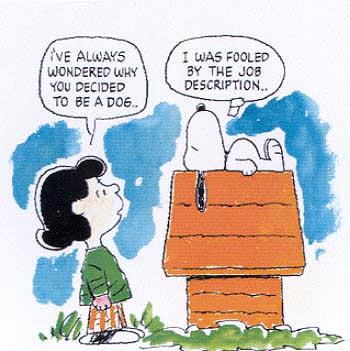
The death knell of the traditional job description is coming ...


I hear a death knell in the distance, it isn’t fully audible but I know it is coming nonetheless. The traditional job description is gasping its last imperfect breaths, slipping down into obscurity with “ineffective” stamped clearly on the headstone ... well, in my mind anyway!

I have always hated job descriptions. This is perhaps partly because I had to re-write each and every one multiple times at a previous job. Having said that the fact that we actually dug them out of the filing cabinet was a miracle in itself.

How many times have you changed roles or been somewhere for a while and realised that you either don’t have a job description or it doesn’t even remotely resemble what you do?

I can’t remember a time when the daily tasks of my role have fitted the description I was given when applying for a job ... and this isn’t necessarily a bad thing. In fact, I am convinced that it is often the things that you do in work that aren’t listed out on a piece of paper that are the most interesting, engaging and enthralling. But that isn’t the issue.

The problem with job descriptions is that they set a rigid list of tasks for something that is undoubtedly going to be fluid. Jobs are multi-dimensional and setting someone in a box either leads to your brightest and most talented employees becoming bored and deserting you or it leads to the job description becoming obsolete and meaningless.

Job descriptions tend to be written with potential applicants in mind. The classic look of horror on an HR personnel’s face when they realise that they are due to advertise a new job opening but the job description is out of date or non-existent. No matter how urgent the job search, nothing will move forward until the job description has been produced and signed off (probably by someone important)!

Writing with a job applicant in mind leads to pages and pages of gumpf that is meant to make the job appear more attractive by including absolutely every task someone might possibly do in a role ... obviously aiming to cast the nets wide in the hope of a good catch rather than being more targeted.

One of my job descriptions, as I came to find after I had started the job, had actually listed the tasks and skills that you would need if you were going to work in every position in the department. I almost didn’t apply because I was nervous that I didn’t have enough experience to work in the role effectively. As it was I was absolutely fine but I ended up doing a number of things that weren’t even on the list anyway (and not doing many of the tasks that were!) ... but it just goes to show that job descriptions can often become deterrents to potential new blood.

OK, so job descriptions are outdated and inflexible. Let’s get rid of them! Ah, but there appears to be a few issues with casting them out forever:
  •           How would we let potential applicants know what a role entails?
  •           Where would we anchor performance metrics to?
  •           How would we iron out the uncertainty of who does what?

These are but a few of the issues with cutting off the age old job description forever. So perhaps rather than axing it all together we need to think of ways that we can be more flexible and move the dusty and rusting job description forward with the times. Making changes to job descriptions always throws up questions around compliance with employment law but in my mind out of date or obsolete descriptions do the same thing so we shouldn’t hold back!

I have listed below a few potential changes that have sprung to mind but I definitely want to re-visit this topic later on down the line (after hearing your ideas too!).
  • Have a core description for a role but leave room for specialisms, specific and developmental projects – everyone will be doing something slightly different
  • Rather than talking about tasks, talk about skill sets – this way the job description will be more adaptable and won’t scare off potential employees
  • Tie performance management expectations with the job description but make sure it is up-to-date and current
  • Don’t just rely on HR to do it all – take ownership, after all it is you that knows what the job entails
  • Don’t be afraid to make changes!

The reality is that organisations need to be flexible and have room to manoeuvre. This is going to be virtually impossible if jobs are inadaptable. If they are flexible and easy to change to suit business needs you are one step in the right direction but this doesn’t mean that companies can sit back whilst job descriptions languish or remain stretches away from the reality. Keeping job descriptions fresh and alive is not just a role for our HR departments but the responsibility of the organisation AND its employees. We must find a way of being more flexible and adaptable whilst having a clear idea of our responsibilities and how, as an employee, we will be measured.


To me, the traditional job description is defunct. I know that something more flexible and interactive is needed but I am not 100% sure what that is yet – what do you think?

Sunday, 16 June 2013

The Call Centre - "Some will, some won't, so what, next!"


I have to hold my hands up and admit to the fact that I am absolutely loving the new tv series - The Call Centre - a documentary centred around Nev, an extroverted Welsh call centre boss who has let BBC3 come into his workplace to see how he runs his business.


His methods are certainly different to what you would imagine. In fact, every time I watch this programme I can't help feeling incredibly sorry for Nev's HR team .... if he actually even has one. His exploits include parading recently dumped employees through the office to "find them a man cos they are desperate", and although said in jest, it can only make me imagine a tonne of lawsuits that must pass his office door on a weekly basis. 

Having said that, Nev has taken his business from 7 people renting a room in a building that the company has just bought to house his 100+ staff. 

Nev must be doing something right!

In an atmosphere that has been often described as "hell on earth", call centres must be one of the hardest places to retain employees and to keep morale high. These employees have to deal with daily rejection and  little sign of any autonomy or variety in their work .... I know, I worked in one during my university years!

With the lack of many of the hygiene factors required to even begin to motivate and engage people, Nev has taken quite a unique and strong stance in engaging with his staff.

He seems to overstep boundaries every 5 minutes, has been known to throw objects at people that yawn in his training and he is happy to humiliate workers at every turn. Yet his staff seem to be enthused by his presence, there is a lower turnover than your average call centre and there is definitely a sense of camaraderie. 

One recent employee, George, who has not been on a date for 6 years was set up with two colleagues by Nev, both of whom got cold feet and knocked the poor guy back. I couldn't help feeling this wasn't really the place of an MD to be setting up his employees but it is all to do with Nev's mantra that "happy people sell" and recently George commented “Nev’s really supportive of everyone, he’s a great boss.”

It has really got me wondering about whether in certain environments many of the "rules" that we imagine are generic across all workplaces just don't apply.

I am going to continue to watch the Call Centre with abject interest to try and work out what exactly is the "Nev Factor" holding this business together so well?

Next episode: Tuesday 9pm, BBC

Monday, 13 May 2013

Why meta descriptions are a largely undervalued facet of search engine marketing

I have recently been working with our digital marketing team on our content marketing. I have had a fantastic opportunity to work on a variety of projects, both big and small. 

When the team came to ask me if I could do them a big favour and help to write over 400 meta descriptions for our website and blog pages, the strained looks on their faces indicated that they knew that this was hardly a glamourous job. Meta descriptions are simply the short descriptions that appear in search results, they don't actually appear on your website.

Meta description tags can be shown in response to searchers' queries, as pictured.

Meta descriptions don't help with your search engine ranking and therefore are often overlooked. However, if your meta description and title compel people to click on your link you will improve your click through rate (CTR) which will in turn improve your search engine rankings.

Despite this, many people don't bother to write custom meta descriptions as they see it as a waste of time. I must admit, it wasn't the most thrilling of jobs and with other 400 to do it did get a little monotonous at times but I can see huge value in having customised meta descriptions rather than letting the search engine pluck its own from your content.

Here's why I think they are important:


- Good descriptions will improve your click through rate which will subsequently improve your search engine ranking
- Having a good description will mean less people go on to your website and leave straight away when they realise it isn't what they were looking for - again improving your ranking
- It is another opportunity to provide a short sales pitch to your potential customers - don't miss the opportunity

How can you make your meta descriptions better?

  • Use targeted key words - but don't stuff them in there for the hell of it!
  • Communicate the benefits
  • Give viewers a reason to click on your link
  • Don't duplicate descriptions, it will improve user experience (you can find out how many duplicates you have in your webmaster tools)
  • If you have 1000s of pages then at least make sure your home page and most popular pages have unique descriptions
  • There is no character limit but only about 150 to 170 characters will appear in the summary - so keep it short!
  • Stick to plain text - avoid hyphens, plus signs and quotation marks
Meta descriptions may not be the most exciting topic in the world but they are certainly important and I will now be spending the next few weeks ensuring that this blog has customised meta descriptions for each post.

Saturday, 13 April 2013

Why buying a house would be so much easier with direct communication!


I am currently in the process of buying my first flat in London with my boyfriend. I have come to realise that this process is absolutely terrifying! Forget about the questions of "am I ready to make such a big financial and relationship commitment", "can we afford to buy our own place?", "am I going to bankrupt my parents when I ask for the largest loan known to man?" - those are the easiest to deal with. The worst bit of buying a property is the lack of direct communication with the seller.

In the past in this blog I have spoken about the importance of body language and communicating with others. It is these things that give us feedback in situations that allows us to make judgements as to how we should proceed. These things are taken away in a process where there are a number of intermediaries between you and the seller. Don't get me wrong, so far our solicitor and mortgage broker have been good but the fact that I don't know what the seller is thinking or feeling means that I can't adjust my approach to ensure that they are onboard and we aren't going to get "gazumped" before completion.

I am used to adopting feedback techniques in my everyday life, both professionally and at home. These allow me to adjust my behaviour, tone or message angle when communicating. I think this is something that many people do without realising but having moved into the world of marketing and communications, it has become more obvious to me now.

The three things you should be 'reading' are:

1) Body language (up to 55% of what we communicate)

The below examples will give you something to look out for but be careful that you don't judge someone's body language too crudely. The key is context.

Positive body language:
  • Moving or leaning closer to you
  • Relaxed, uncrossed limbs
  • Long periods of eye contact
  • Looking down and away out of shyness
  • Genuine smiles
Negative body language:
  • Moving or leaning away from you
  • Crossed arms or legs
  • Looking away to the side
  • Feet pointed away from you, or towards and exit
  • Rubbing/scratching their nose, eyes, or the back of their neck

2) Tone of voice

Have you ever heard the saying "it's not what you say but how you say it that counts"? Just think about training a puppy. They can't actually understand the words we are using but they can comprehend the tone and sound coming from us. Often when we require an animal to follow an instruction we use strong staccato phrases, such as 'sit', 'stay' and 'fetch' coupled with body language.

In a face-to-face conversation with another person the tone of voice can really change the meaning of a conversation in its entirety. Read the following paragraph. Imagine this is a friendly colleague at work trying to help you out in your first week. She has a calm and sincere tone.

"I would suggest that you look at the other information available so that you can make an accurate estimate. A piece of advice, don't enter any information into the database until you are sure it is correct"

Now read this paragraph again and imagine that this is a patronising Manager who seems to be insinuating you don't pay enough attention. The tone of voice is harsh, patronising and sharp.

Can you see what a difference tone of voice can make? Why not try an experiment by changing your tone of voice to see what sort of a reaction you get.

3) Facial expression

Most people won't give you an obvious signal, such as frowning (although I do know someone who does!), but they may furrow their eyebrows slightly if they don't understand or disagree. Don't be fazed by someone's facial expressions, just use them as a cue to ask more questions, clarify your point or take a step back.

Don't forget that your own facial expression can sometimes give you away too!!

I am hoping that we will be able to complete our flat purchase shortly but in the mean time I guess I will just have to do without the normal communication signals that I have come to rely upon in negotiations.

Saturday, 9 March 2013

The importance of grammar and punctuation

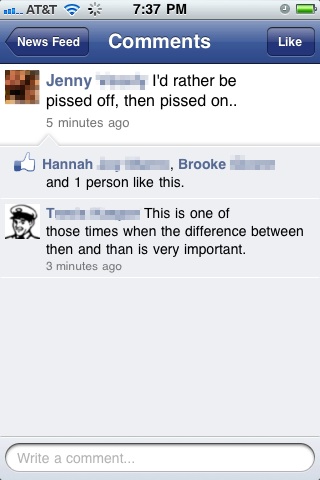
Last week I met someone from The Queen's English Society, a group of people brought together by their real desire to ensure that the proper use of the English language is upheld. I appreciated their cause but not because I believe that everyone should know their prepositions from their dangling participles, but because we all make basic grammar and punctuation mistakes on a daily basis that actually change the meaning of what we are reading, writing or saying.

In this blog post I just wanted to share with you some of my favourite images that show these atrocities in action! (all just a little bit of fun!)


Tuesday, 5 February 2013

20:60:20 - The engagement rule


Last year I had the pleasure of working with a pair of engagement consultants who gave me and the rest of the senior management team some great advice and tips on how to engage our employees effectively.

The concept of the 20:60:20 rule was one that I had seen prior to this meeting but they approached it very differently to how I had seen it used before.

Explanation of the traditional 20:60:20
  • The Top 20% comprised of strong performers
  • The Middle 60% comprised of average performers
  • The Bottom 20% comprised of weak performers
Simply you leave the top 20% to their own devices, giving them opportunity for autonomy, the middle 60% you concentrate most of your time on, developing the potential and the bottom 20% you need to manage most vigorously.

Explanation of the engagement 20:60:20


·       The Top 20% comprised of strongly engaged employees
·       The Middle 60% comprised of averagely engaged employees
·       The Bottom 20% comprised of disengaged employees


When I first saw this model I was convinced that you should spend trying to increase engagement, specifically in the bottom 20% as I have always believed that disengaged employees may often have a reason for this caused by the company (eg. been passed over for promotion, doesn’t feel they are trusted, is never offered more autonomy etc) but I was told that this was the wrong way to look at it. Over the past year or so I have come to agree with the engagement model and I wanted to share their advice with you.


Please note: The top 20% are not necessarily the “best” at their jobs, but they are the people that most demonstrate your company values. This is important because skills can be learnt, whereas high performers with attitude problems are hard to change and can cause friction across the business.

The top 20% should be given the most opportunities and attention. These people will act in the best interests of the company, so give them the autonomy to get the job done. Challenge them and grow them. This group should be offered development opportunities first.

The middle 60% should be given training opportunities to develop the basics but development opportunities will always be offered to the top 20% first. This group should be encouraged but main focus should always remain on the top 20%. This 60% will see the benefit of showing themselves as more engaged with the business (eg. loyalty, extra effort, company-wide thinking) and will often mimic the behaviour of the top 20%.

The bottom 20% should basically be ignored. Obviously from a functional capacity they will receive job training but they do not get access to the extra development offered to those in the top 20%. This group will make one of two choices, decide that they want the opportunities and therefore change their behaviour or they will leave the company.  

As this process continues to work, your bottom 20% will move up to the level of the bottom of your 60%. You will always recruit people who are the same or better than your top 20%, this means that you will constantly be moving employees up.

I am not suggesting that you have a list of which employees lie in which group, this would be pointless because it can change frequently. It is more a litmus test that says that we pay most attention to those who most demonstrate the company’s culture and reward them for their behaviour.

The one thing that they said that really stuck with me was:

“If you focus all of your attention on the bottom 20%, the whiners and moaners, everyone else in the company will see which way you are looking (backwards) and start to follow, if you are always looking forwards that’s where they will all aim”.

Anyone who has worked with horses will know, you can lead a horse without a head collar or rope, if you walk with your eyes forward they will come. The moment you turn round and try to coax him, the horse will be confused because you are facing backwards and trying to control. This works the same way with people – face forward, take them with you and they will follow.

Wednesday, 2 January 2013

How to get your boss to agree to a Christmas Party next year!


With the Christmas decorations hanging lopsided and mince pie foil cases well and truly emptied, I wanted to examine the benefits, or perhaps just perceived benefits, of the “Work Christmas Party”.

This annual event used to be something of a “given” in most companies, prior to the 2008 economic slump. In fact it was seen as a great way of showing gratitude, albeit in a very expensive way, to employees at the end of the year. Since the economy became more turbulent, companies have been reassessing these ‘luxuries’ and many have chosen to cut back, with some deciding that it is inappropriate to have a Christmas party.


But what positive or negative impact can a work Christmas party have? Is it worth the money or just another way of ending up with inter-team trysts, blushing cheeks for the month of January and a sore company bank balance?

I think I may be slightly biased. For the last two years I have been involved with the running and execution of the Christmas ‘do’ at the companies I have worked for and each time I have had a blast, as have my colleagues. However, the real question is, does the company get enough bang for their buck?

The answer is obviously variable. To get a return the event must be planned to specifically aid the team in some way. For example, rather than just having food and drinks in a stuffy restaurant where someone is definitely going to end up cornered on a table with the bore from legal, why not involve an element of team building and relationship building. If possible, try to avoid sit down meals; people are far more likely to mix if they are standing rather than static at a table.

Treasure hunts or team competitions can be organised cheaply with a little DIY and are great at creating a competitive spirit that helps to bond teams. Charity events can also give the team a good feeling of festive spirit, perhaps the team could help to box gifts for the less fortunate or visit a local hospital as a team to give presents to the sick.

Most importantly, make sure you mix people up; don’t let everyone stay in their cliques. Creating stronger relationships between colleagues and across the business is paramount to a more effective working environment which in turn can increase productivity and therefore the bottom line. A great Christmas Party will keep an excitement alive for the coming months but it shouldn't be a one-off. Continue to get the team involved in the team-building events throughout the year (although perhaps with a little less alcohol involved!)

One important point to remember is that not all Christmas events need to be expensive. This year we had a budget of £25 per head for a team of 40 and with this we managed to spend a successful day in teams on a treasure hunt in St. Pauls (bought from the internet for £29.99) followed by food and drinks in a wonderful bar in Clapham Junction (The Plough – if anyone is interested). You can also find things to do for free or even ask your colleagues to chip in a small amount of money towards part of the evening. As a prize for the winning team, I bought flashing Christmas hats, presented them with a certificate and managed to convince the bar to give us a bottle of prosecco on the house. The prize may sound small but the winning team proudly showed off their hats and certificate.

Quite simply…
As long as the event is engaging, builds relationships and allows people to let off a little steam – most will be happy, engaged and it will have a positive impact. I say most because it is inevitable that you will have at least one person that thinks they could have done better or does not want to be involved. My opinion on this matter is – who cares?? I always follow the 20:60:20 rule. Concentrate on the top 20. The middle 60 will follow because they want to get the same attention as those at the top. The bottom 20 will either eventually see that everyone in the top 80 is having such a great time that they want to be involved or they will leave.

Don’t waste your time on the moaners!

I think that Christmas events are a fantastic way to creatively engage your people, whilst recognising them for their hard work. Many companies have decided that a Christmas Party is just too expensive at the moment when cuts are being made, but they don’t have to be expensive. Employees know that gone are the days of the big, expensive, all-company parties in a posh hotel. Why not get their input on how you can DIY the Christmas Party – I bet they would have some great ideas!!!

What did you do for your Christmas Party this year? Was it any good, how would you have made it better?

Tuesday, 4 December 2012

The art of blogging


Well, I certainly outdid myself this time ... I have not written a blog post in over 2 months! One of the first rules of the blogging world is to make sure you communicate regularly and consistently with your audience. This way you keep them engaged with new content and they know when to expect your next post.

I think we can all agree that I haven’t done this very well.


I could sprout the million and one reasons that I have been feeding to myself about why I am not writing regular posts but it still doesn’t give us the solution that a blog is successful. So in this post I thought I would write 10 key tips for maintaining a blog and the things that I wish I had been told before I set mine up! This is very much a case of “do what I say, not what I do”, so please do bear with me.


  1. Choosing the platform – There are lots of blogging platforms out there (eg. Wordpress, Tumblr, TypePad and Blogger) and choosing which one to use can be confusing. Unless you have very specific ideas about functionality, most blogging platforms will do what you need. You can find a number of helpful video tutorials online
  2. Find your niche – As mentioned above, when you start a blog you need to provide regular content. Make sure you find a theme/area of real interest where you are going to be able to share your opinion passionately. Try to think of an angle that makes your blog different to everyone else's
  3. Get ahead of the game - Before you even launch your blog, make sure you have already written 4-6 posts or so that you can release them at regular intervals in the first few weeks. This will give you time to plan your next posts and also make sure that you start yourself on a path of regular and consistent contact from the very beginning
  4. Plan your content – Dream big and don’t leave your content to chance. Good ideas will not generally come to you on the spot, so make sure you note down any ideas that cross your mind. Spend a few minutes every day thinking about potential topics and content
  5. Choose your objectives – Some people write blogs just for themselves (and maybe friends) but if you want your blog to gain a good level of readership traffic you will need to think about how you market yourself and your page. Start chatting with other bloggers and leaving useful comments on other blogs (with some link to your blog's theme) and show yourself as a thought leader - this will help to draw traffic to your blog. Search Engine Optimisation (SEO) is always really helpful and you can find many self-learning resources online
  6. Encourage interaction – Sometimes blogging can feel like a one-way conversation ... but it shouldn’t be. Encourage feedback and opinions to be shared, whether through the comments box or by having guest bloggers. NB: Blogger annoyingly only allows users with a gmail account to post a comment!
  7. Track your stats – Keep an eye on your analytics, it will help you to understand what your readers are interested in and allow you to provide them with more of what they are interested in
  8. Be personal – Humans are a nosey bunch and we love to find out personal things about people. It may be nerve-wracking but the more personal and human elements you add to your posts the more likely people are to come back to read more
  9. Get social – Don’t neglect your other social media accounts. Use twitter, facebook and LinkedIn (to name but a few) to direct people to your blog and also to start conversations around the topics you are discussing on your blog
  10. Keep it professional – No matter how informal your blog is, make sure you grammar and spell check before posting. Remember that your blog will become like an online reference for you to future employers. Silly things like bad grammar and an obvious lack of attention to detail will cost you dearly!


As I said before, do what I say and not what I do. Following the above tips will not automatically give you a high traffic blog but it will certainly help your chances!

So ....... anyone want to add their opinion and comment on this blog? :P Any extra tips or suggestions for improvement would be greatly appreciated.
                              

Tuesday, 25 September 2012

Why do we have such a problem with presenting well?


Today I attended a large employee benefits conference in London. Unfortunately the organisers had made a few errors, such as an inefficient queuing system that made the sessions start late, conference rooms that were badly soundproofed and a lack of microphones to capture the questions from the audience.

Despite this, I was excited to listen to the presentations and hopefully maximise my day out. Overall it was an interesting day but I couldn’t help muttering inside my head about some of the poor presentation slides and skills that some of the speakers graced us with (however I do want to say that there were some very good speakers too!).

One of the presenters showed us their company’s history as a timeline. However, on this one slide there was at least 200wds of text! Although they had tried to break the text up with images and coloured text boxes it was still completely incomprehensible and ultimately just detracted from the message they were trying to get across to the audience. Most people know not to read off the screen but that doesn’t mean you can just write everything that you don’t say!

The second issue was more to do with the actual speakers. Now I don’t want to be precious but having been a member of toastmasters, I am used to counting “ums”, “ahs” and other crutch words ... and I had a field day today. I understand that many of the presenters were chosen more for their knowledge of employee benefits rather than their presentation skills but I was still disappointed. The problem is that these crutch words interrupt the flow of speech and are often very distracting (particularly for someone who is trained to pick them out!).

Today has prompted me to write a quick blog post about the things we should think about when presenting. I am not going to talk too much about how we speak when presenting as I covered this in a previous post. However, here are a few pointers when putting together presentation slides (whether using powerpoint, prezi, HTML5 etc).

  1. Your slides should not be the main focus – you are! Use it to add (not detract) to what you are saying and don't hide behind your presentation!
  2.  Use images! People find it difficult to read something on a screen whilst listening to what someone is saying – we are not very good at processing two bits of information at the same time
  3. Key points only – when you use words on a slide it should be to illustrate key points or facts and it should be short and snappy
  4. Keep your words to a minimum. You should really have no more than 33 words on a slide (and it will be better with less!)
  5. Make two versions. When talking to people about presentations they often tell me that the reason they put so much information on them is so that people can refer back to them at a later date and fully understand what was being said. If this is the case, do two versions; one for the actual presentation and one as a reminder of what was said
  6.  You don’t have to use powerpoint. Visual aids are used to add to a speech and sometimes powerpoint can be very restrictive. When we present we want to have a conversation with an audience and human conversation is not structured as rigidly as the traditional format of a powerpoint 


An example of a bad slide

Sunday, 16 September 2012

The role of social media in customer communications


In the last couple of weeks I have become rather obsessed with my twitter account and not because I want to tell people what I have just consumed for breakfast.

Last week on the way to work I realised that I had forgotten my annual season ticket (a piece of paper worth over £2000!!) and had to buy a return ticket. I didn’t mind doing this as I knew that I had read on the train provider’s website that they would refund in full the first ticket bought in the case of forgetting my annual season ticket.

To be honest I forgot about the ticket for a few days and then turned up at Clapham Junction station at the customer service to request a refund. The abrupt lady at the desk told me that I couldn’t get a refund from here and I must go back to the place where I purchased the ticket and discuss it with them there. I was a little annoyed but it made sense as I presumed they had to keep track of it somewhere. The following morning in Dorking I repeated my story to the customer service desk. I was unhelpfully told that I would need to produce my actual ticket as well as my receipt in order to receive a refund. I have to admit that I sarcastically asked whether he meant the ticket that had been “swallowed” by the ticket barriers in order to allow me to exit the station. He told me that I should not have used the tickets at the barrier! (Still trying to understand the idiocy of this comment!)

After a frustrating 5 minute conversation about how I would not be receiving the refund I was entitled to, I left feeling let down and quite frankly, annoyed. It was at this point I turned to my twitter account to tweet my annoyance at the situation directly to Southern trains head office. I have used this tactic a few times and tend to get a fairly swift response and so I wasn’t surprised when I got a public message within 3 minutes asking me for further details.

I don’t know whether it is the fact that social media customer service teams are often a dedicated resource or whether it is because companies are more aware of the impact public negative feedback can have but I always seem to solve issues with companies quicker if I do it online in a public forum.

Within 5 minutes of tweeting I had been sent a PO BOX address in Bristol that I could send my receipt to and expect to receive a full refund ... something that one of the face-to-face customer service team should have been able to tell me. It would have saved a lot of huffing, puffing and frustration.

On the other hand I recently read a story about someone who received instructions from a company’s social media team that referred them to another part of the business ... that then did not deliver and the person felt even more let down and frustrated then before. There is also the worry that twitter's ability to give instantaneous responses could potentially be harmful if those using it are not properly briefed or trained.

I am interested to hear what your opinion is on the place of social media within customer service communications? Is it revolutionising our customer solution strategies or is it just making it more complicated with the potential to easily damage their organisation’s reputation?

I would be interested to know your thoughts. 

Friday, 31 August 2012

Taking engagement to a higher level


Apologies for being so slow in putting up my latest blog post! I have had a crazy 4 weeks getting really stuck in to my new job, finding a new kickboxing club and meeting up with friends. However, I promise to face my blog with renewed vigour now!
After a number of posts about communication failures, I thought I would make the tone more positive in a post-celebration of the fantastic London 2012 Olympic Games (and hopefully Paralympics too)!

We talk about employee engagement as the ultimate goal for organisations wishing to raise productivity and consequently the bottom line. Often though we are not actually sure what engagement looks like or what we have to do to achieve it. To me, engagement is epitomised by the connection that people have with an organisation and the extent to which their own personal goals are aligned with that of the wider “vision” or goal.

During the Olympics I believe that I saw true engagement in action and I was thrilled to be in London whilst it took place. The dedication and passion of the 70,000 Olympic volunteers (aka Game Makers) has absolutely astounded me. I was lucky enough to attend two Olympic events and as cheesy as it sounds, it was the volunteers (including the armed services and police) that made the day for me. Smiles all round, well timed jokes and helpful directions were the norm and everyone, from the coveted positions of athletic guides to the volunteer cleaners, was welcoming and certainly shared their excitement at being part of this momentous event.

So how exactly is it that LOCOG, the organisers of the London Olympics, managed to have such an engaged workforce? Now I know some of the cynical of you will be thinking that it can’t have been that hard considering that these people chose to give up their time and work at the games for free. However, you forget that these people were often travelling long journeys to arrive at the venues and had long hours to work, something that would test anyone.

I believe that the reason that the Games Makers were so engaged was that they were able to align their own personal goals with that of the wider vision, “to set new standards, creating positive, lasting change for the environment and communities” and “to inspire a generation”. LOCOG demonstrated to volunteers the impact that each and every one of them would have on achieving the overall goal.

Turning this back to the corporate world, I think it is safe to say that companies that manage to show employees how their day-to-day work counts towards the bigger picture can often be the most successful. It is not just the “Innocent” and “Save the Children” brands of this world that can inspire their employees. Every single company has the opportunity of including their staff in the future of their business and they also have the moral responsibility to inspire them too. It may be harder to convince critics that you can ‘inspire’ those in the less ‘glamorous’ roles within a company ... and I would agree. However, it is definitely not impossible. Autonomy is the key. Allowing employees to take responsibility, be accountable and share their knowledge and opinions is an important part of engagement.

There is the story of Kennedy visiting NASA in 1962 to take a tour and meet the people. Whilst walking through the building he stopped to talk to a janitor and asked him what he did at NASA. The janitor proudly told Kennedy, “I’m helping to put a man on the moon, Mr. President” - A wonderful sentiment.

We can all work to achieve this level of engagement amongst employees – it is possible but be aware that once you begin on this journey you can’t leave it by the wayside. In fact, it is better not to start at all (raising the hopes of your workforce) then to do it in half measures. This is not to say that you shouldn’t try, but you need to be committed.
To business owners I say, invest in your people. Inspire them, nurture them and invite them to ‘buy-in’ in your business, just as you have.

To those who have not quite made the top yet, demonstrate your interest in the bigger picture, encourage your business leaders to listen and as you move up the ranks, help to inspire those following you.

Companies that engage their staff not only end up having the best pick of future talent, but they also open access to innovation, continuous improvement and importantly, increased productivity!

If that isn’t worth your time and effort – what is??

Tuesday, 31 July 2012

Another one bites the dust - Bloc Weekend 2012


Since my last post, I have been told about another total communications disaster ... but this time it wasn’t anything to do with G4S. In fact it was the electronic festival “Bloc Weekend” (July 2012) who had to close their festival down during the event amid fears of overcrowding. The event organisers brought in the police to aid them to ‘eject’ thousands of festival goers and faced a vicious backlash across all social media sites.

However, whilst the company was frantically trying to deal with the chaos unfolding they forgot to communicate with their customers. Specifically, when they took the decision to eject people from the venue, they forgot that they had authorised a number of “pre-set” automatic tweets to be sent from their twitter account, @BLOCWKND. Whilst festival goers were slamming the festival’s ineptitude and complaining profusely about the manner in which they had been thrown out of the festival, @BLOCWKND was telling them that the next artist was coming up and posting “here’s one I took earlier” photos.

Unfortunately, the use of programmes that send out pre-set automatic updates is used all too frequently by companies and their self-titled “social media experts”.  Now, I don’t think there is anything inherently wrong with using automatic update programmes, such as Hootsuite, Tweetdeck or Tweetadder, but ... and this is a massive BUT, you have to understand that social media networks are all about being socially interactive and reactive. An automated system will never be able to do this for you; it all requires a human element. By making the mistake of not managing this process, @BLOCWKND found themselves further angering their customers as they continued to tweet inaccurately. What is more, when they did realise what had happened they went silent for some time.

Finally they sent out a status saying:

“By now everyone will have heard that Bloc 2012 was closed due to crowd safety concerns. We are all absolutely devastated that this happened, but the safety of everyone on site was paramount. Given the situation on the ground, we feel that it was the right decision to end the show early. Bloc will not open on Saturday 7th July so please don’t come to the site. Stand by for full information on refunds.”

Now I may be being silly but for the life of me I cannot find an apology in that status. I can’t even find the classic “we are sorry for any inconvenience caused”. Interestingly, Base Logic Promotions Ltd (the company name behind Bloc Weekend) quickly went into voluntary administration following the fiasco meaning that attendees of the festival will struggle to retrieve any refunds. I am not implying in any way that a better communication strategy would have saved the company from administration or from their overcrowding issues, however, I think they owed it to their disappointed customers.

My real point in this blog is that we have to be careful with our social media tools. It is all very well finding tools that help us, as companies or even individuals, to make the most out of social networking. However, we must not forget that these processes have to be managed properly if we choose to use them. Our customers, friends, circles and followers demand that we interact with them freely, openly and honestly, this was an unfortunate example of the exact opposite.

This says it all ...

Tuesday, 17 July 2012

Honesty really is the best policy!


What is it exactly about bad communication that makes a situation/issue/challenge ten times worse?

We have all sat on a train station platform or airport when the LCD screens flash to tell you that your train/plane is delayed by 20 minutes. Doesn’t seem too bad, right? But following this, every 5 minutes, the delay seems to increase and before you know it you have been waiting for 90 minutes with only a mechanical voice “apologising for the inconvenience”. I don’t know about you but this reoccurring situation infuriates me. I can’t understand why people aren’t more upfront and honest about issues. I would much rather be given the most correct and up-to-date information at the time to be able to make my own decision as to how I will proceed. There is nothing worse than sitting on a train station platform and realising that you could have gone out to the pub for 40 minutes whilst you were waiting.

An interesting situation to assess right now is that of G4S, Olympic security provider, who have been plagued with problem after problem in recent days relating to the under-staffing of security posts for the impending Olympics. Currently there is a lot of scaremongering in the press about the lack of trained security personnel that were meant to be provided as part of the 10,000 person contract and 3,500 Army personnel, due to go on leave, have been brought in at the last minute. Anyone following this story will see that the obvious mistakes made plus the media furore and high profile “dress downs” have turned G4S and the security aspect of the Olympics into an absolute shambles.

3,500 soldiers are drafted in to plug the
security personnel gap at the Olympics. 
At this point in time, we can only allege as to where the communication break downs have happened. Boris Johnson seems to think that Government were aware of the staffing issues a few months ago, whereas Theresa May insists she only found out 9 days ago. It is interesting to note that many reporters have failed to alert readers to the fact that the initial G4S contract was based on the employment of only 2000 security personnel, not the 10,000 that it increased to in January of this year. So where exactly does the blame lie for this complete and utter breakdown in communication?

Over the coming weeks, as more information surfaces about the mistakes that have been made and the real situation behind the hype starts to appear, I would like to have a look at ways in which the situation could have been handled more effectively by G4S and Government. Please do feel free to add your own comments and thoughts.

Tuesday, 10 July 2012

Times are changing ...


Firstly I want to apologise for not writing a blog post for four weeks! It has been a month of highs, lows and significant change. I made a decision to follow Paul to London, leaving my Cheltenham life, job and friends behind, and have consequently been submerged in the chaos of moving, going to Hideout festival in Croatia (yes, I can feel your sympathy flowing!) and starting a new job.

Over the last few weeks I have experienced immense turmoil at the thought of leaving friends, even though it has been sprinkled with elation at the prospect of reacquainting myself with old friends and making new ones. However, the thing that has become most clear to me is the importance of the relationships you form with people throughout your lifetime and the potential impact that these interactions can have.

If I mentioned Winston Churchill, Nelson Mandela, Mother Teresa, Martin Luther King and Marie Curie, what would you say that had in common? Well, apart from being famous enough that you know who they are, these people have had a significant impact on the lives of others. Some of them used the power of rhetoric to inspire and others used their actions to have a profound impact.

However, these are people that we may not feel have directly impacted on our own lives. Often it is the unsung heroes; parents, teachers, friends, partners and groups of like-minded individuals that leave the most lasting impressions. These people may never have their name in shining lights, or remain imprinted in the minds of millions across the world but nonetheless they often deeply influence our lives, the experiences we have and the people that we become.

In Cheltenham, I encountered a number of individuals who have really managed to touch upon my life and I hope that in my last few weeks I was able to articulate to them the impact that they have had. This blog post was really about reiterating my thanks to all of you who have been part of my Cheltenham life and all of you that have made me who I am today (you can all share in the blame :P).

Sometimes it is important to think about the positive impact that you can have on those around you.

Jackie Robinson once said: “A life is not important, except in the impact it has on others”

I don’t think you need to be famous or well-known to have an impact, we just need to be aware of the experience, advice and support we can give to others. If life is measured by the impact we have on others, I would say that I must be surrounded by many people whose lives are pretty darn important!

Wednesday, 6 June 2012

Presentations – How to keep your audience awake!


We have all been there, sat waiting for an inevitably dull Power Point presentation delivered by an equally as dull presenter with zero charisma that seems to last for hours. Occasionally you get the odd surprise but they tend to be the minority. So what exactly makes a presentation engaging and actually worth watching?

I could go on about how to develop your content, how to structure your presentation or which programmes to use but I won’t have the space to fit it in! Instead I have put together my top tips for actually giving presentations and making sure that your audience stays awake and engaged in what you have to say.

 Inspire confidence
Your knees are knocking and the room feels like you are in the Caribbean, but you must try and show confidence in your body language and the way in which you speak. Make sure that you know your topic well, as this will help you to relax and also take a deep breath before you start.

Maintain eye contact
As mentioned in my previous post, eye contact is an important way of engaging with people. You don’t need to try and look at everyone at all times, you’ll end up looking like you are watching a Wimbledon final, but you should ensure that you include the whole audience throughout your speech.

Make yourself heard
Speak clearly and project your voice so that every member of the audience can hear you, even the best presentation will fall by the wayside if your audience can’t hear what you are saying. Try and imagine someone who is hard of hearing sat at the back, you need to make sure that they can hear every word of your speech.

Don’t rush!
Make sure you vary your pace and tone in order to keep the audience interested but be careful not to rush, otherwise your audience may lose track of what you are trying to say.

Pauses are your friend
We all have crutch words, such as ‘um’, ‘ah’, ‘basically’, ‘and’, and many others but pauses can be used for impact and to give you time to think about what you are about to say. This can really help to eliminate your crutch words, so try to practice it in everyday life, not just in your presentations.

Vary your vocab
There is no need to introduce jargon or long words for the sake of it but rhetorical devices can add colour and animation to your speeches. Some examples of which can be found below:

Alliteration
 repeats the same sound at the beginning of nearby words – What my Wife Wanted
Assonance – repeats the same vowel sound in nearby words – How Now Brown Cow
Metaphor is when two unconnected things are compared – Life is a Highway
Similes are the same as metaphor but using the words like or as Forrest Gump said Life is like a box of chocolates


Enjoy yourself
Although presenting or making speeches may not be your most treasured past time, try to enjoy it! Presentations and speeches are a great way to connect with others and to share your knowledge. At the end of your presentation, make sure you await your rapturous round of applause!

With my tips, I hope that you will find your audience awake and engaged!